

Your organization should update its crisis communication plan more than once a year to be truly prepared for any scenario. Otherwise, treating it as a fixed document that rarely or never gets reviewed leaves your brand exposed to reputational damage. Here’s everything you need to know about effectively maintaining your crisis communication plan template.
- What Is a Crisis Communication Plan?
- When Should You Update Your Crisis Communication Plan?
- How to Update Your Crisis Communication Plan
What Is a Crisis Communication Plan?
A crisis communication plan is a strategic guide that outlines how an organization will communicate during a disruptive event or emergency that threatens reputation, stakeholders or operations. Your crisis communication plan should define:
- Who is responsible for communication
- What messaging will be delivered to your audiences
- Which channels will be used to reach them
While updating your plan, remember your primary goals for establishing crisis communications are:
- Containing the situation by controlling the narrative
- Providing clear, factual information to prevent rumors and misinformation
- Maintaining public, employee and investor trust
When executed properly, this plan helps your organization respond faster and better to crises to minimize long-term reputational damage and disruption to operations.
These PR challenges sound familiar?
Let's explore how strategic communication can move your business forward.
Schedule a ConsultationWhen Should You Update Your Crisis Communication Plan?
At a minimum, you should update your crisis communication plan annually, but it’s better to review elements of a crisis communication plan quarterly, after any major organizational or industry change, once you’ve finished a crisis training drill and post-crises to catch critical gaps sooner than once a year.
Quarterly
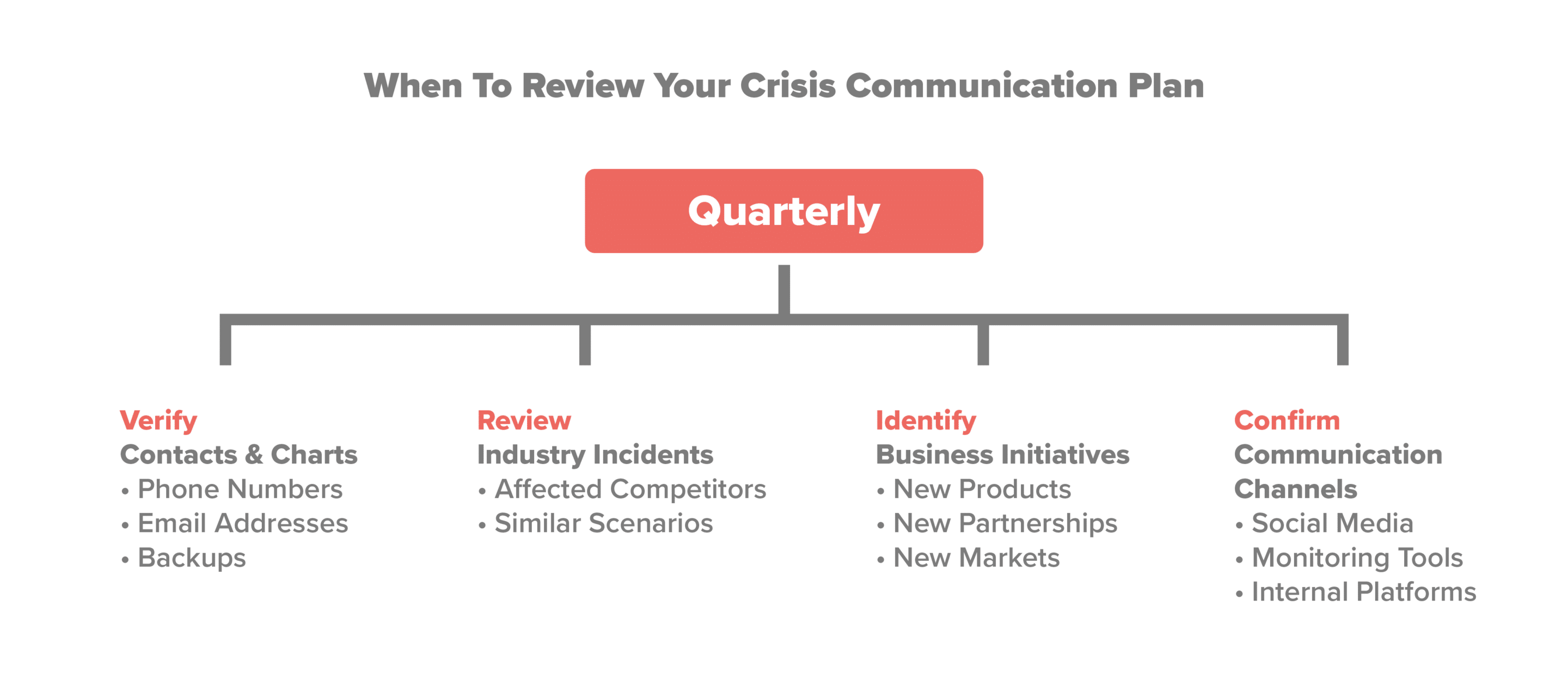
Three months is long enough for meaningful organizational changes but short enough to prevent contact lists from becoming outdated and team members from forgetting their roles. During quarterly reviews, focus on:
- Contact lists and org charts: Verify all phone numbers, email addresses and backup contacts are current
- Recent industry incidents: Review crises that affected competitors or similar organizations and assess whether your plan addresses those scenarios
- New business initiatives: Identify any new products, partnerships or markets that introduce new risks
- Communication channels: Confirm social media accounts, monitoring tools and internal platforms are still active and accessible to your crisis communication team
These focused reviews typically take a couple hours and can be delegated to a communications specialist if your full executive team cannot participate.
With Major Internal or External Changes
Major transitions create immediate vulnerabilities — new team members don’t know crisis protocols, new communication platforms lack monitoring and emerging risks aren’t addressed in your existing scenarios. Waiting until your next scheduled review means operating with an outdated playbook during periods of heightened scrutiny and risk.
Examples of major changes that warrant a special audit:
- Leadership transitions: New executives may have different communication styles, risk tolerances or media experience levels. Update spokesperson designations and approval chains, and train new leaders on crisis protocols.
- Mergers or acquisitions: Integration creates new stakeholder groups and potential culture clashes. Include integration-specific risks (employee dissatisfaction and customer confusion) and ensure teams have unified messaging.
- New regulatory requirements: Industry-specific regulations (data privacy laws, safety standards, disclosure requirements) directly impact what you can say, when and to whom. Work with legal counsel to update holding statements and approval processes.
- New communication platforms: A new social media account, internal communication tool or customer portal means new channels where crises can emerge and spread. Add these platforms to your monitoring protocols and determine who manages crisis communication on each.
- Geographic expansion: New locations bring new risks — different cultural expectations, local media landscapes, regulatory environments and potential crises (natural disasters, political instability). Develop location-specific response protocols and identify local spokespeople.
- Product or service launches: New offerings introduce new failure points. High-profile launches especially should get scenario planning for product defects, safety issues or unmet customer expectations.
Have your communications director lead a review within 30 days of the change, pulling in legal, HR, operations and other departments based on the scenario’s need. Minor changes could take a couple hours while a comprehensive overhaul of your plan could take multiple workshops over several weeks.
After a Crisis or Simulation
Drills and real-world incidents reveal what worked and what didn’t in your plan, and where messaging, response times or decision-making processes need improvement. Updating immediately after these events helps you capture insights while details are fresh so you don’t forget and repeat the same mistakes.
After a real crisis:
Within 48-72 hours of resolution, document:
- Timeline gaps: Where did delays happen in notification, approval and message delivery?
- Messaging effectiveness: Which statements resonated? Which created confusion or backlash?
- Channel performance: Which platforms reached your audiences? Were any overlooked?
- Role clarity: Did anyone hesitate because of unclear authority? Were there duplicate efforts or dropped responsibilities?
- Stakeholder reactions: Did any group react unexpectedly or feel excluded?
- Missing resources: What pre-approved statements, templates or monitoring tools would have helped?
After a crisis simulation or tabletop exercise:
Plan a two-hour debrief immediately following, with updates incorporated within two weeks. Evaluate:
- Decision-making speed: How long did approvals take? Delays in simulations will be worse during actual crises.
- Knowledge gaps: Which team members were unclear on their roles or needed to constantly reference the plan?
- Messaging adequacy: Did holding statements provide enough guidance, or did participants feel they needed more specifics?
- Cross-team coordination: How smoothly did communications, legal, HR and operations collaborate? Where did handoffs fail?
Your communications lead should facilitate a group discussion with everyone involved in the response. Run simulations of varying scenarios at least twice a year and document, document, document.
How to Update Your Crisis Communication Plan
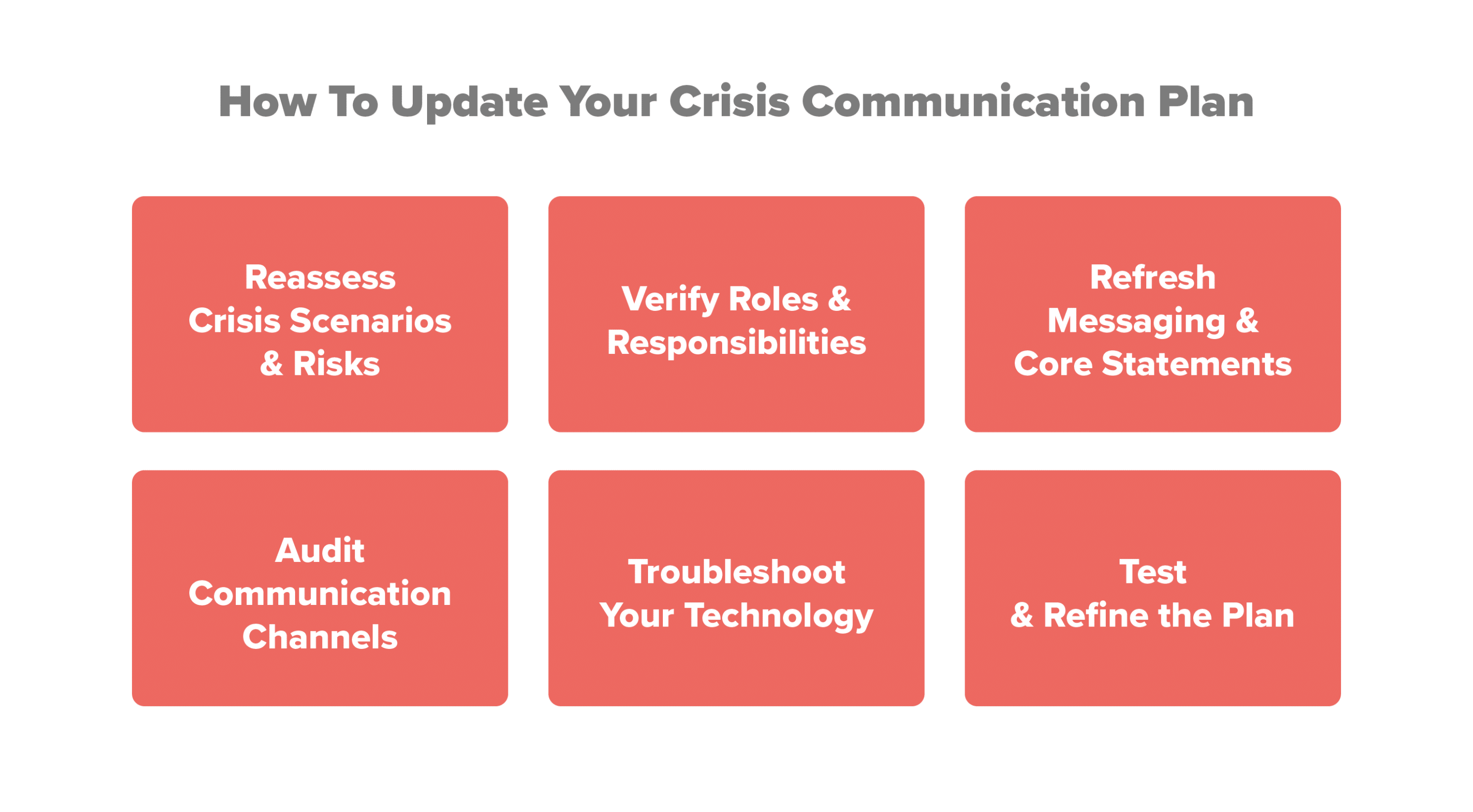
To update a crisis communication plan effectively, treat it as a living document that evolves alongside your organization and the risks it faces. Regular, structured reviews — not just annual ones — keep your plan accurate and actionable when it matters most. Here’s a step-by-step process.
Reassess Crisis Scenarios & Risks
Start by checking that all the after-action reports from your recent exercises and real-world incidents are in the most recent version of your plan. Then, consider emerging reputational risks that your plan doesn’t already cover — brought on by new regulations or business structures and offerings. Pay close attention to cybersecurity threats, leadership updates, additional channels and tools, shifting public expectations and more.
Verify Roles & Responsibilities
If even one internal or external role listed in your plan is outdated, it could throw off the entire chain of command and severely harm your response time.
Confirm that all emergency contacts — executive leadership, designated spokespeople, legal counsel, human resources, media partners, communications teams and any other advisors or agencies — are accurate and their contact details are up-to-date. Do the same with your org chart. If not already available, give every role in your contact list an alternative contact method. And clearly define escalation paths and approval processes.
Refresh Messaging & Core Statements
Does your crisis communication messaging framework reflect current brand values and legal requirements? Have your message maps been recently edited based on what’s resonated with your audiences in scenarios and past crises? Update your holding statements, key talking points and response templates for press releases, social media posts, internal memos and customer emails so they are ready for immediate use and aligned with how your organization communicates today.
Audit Communication Channels
People are constantly changing how and where they get their information, so a statement that might’ve reached your audience last year might not make it to them this year. That’s why your plan needs to adapt to platforms people are actually using.
Do you have the right tools for email, social media, media relations, customer communication systems and other platforms? Does your plan have a response to correcting misinformation on these channels? Does each channel have someone assigned to monitor it during a crisis? And can every platform push out your message within minutes?
Then consider your internal communications strategy. In a crisis, your employees will likely be answering questions from customers, so it’s important that they have accurate information to share. Send email updates, keep your internal website current or set up a hotline for staff to ask questions and report problems.
Troubleshoot Your Technology
Technology that fails during a crisis — whether it’s locked accounts, overloaded servers or broken notification systems — forces you into damage control when you should be getting ahead of the situation.
Test your mass notification or emergency alert system by sending a message to a small group. Confirm it delivers immediately across all intended devices and reaches recipients without delays. Work with IT to verify your website can handle sudden traffic spikes. If you plan to host crisis updates on your primary site, ensure it won’t crash when stakeholders flood in for information. Alternatively, determine if your IT team can build a dark site — a pre-built webpage that remains unpublished until needed, then can be quickly launched as a dedicated landing page where up-to-the-minute crisis response information can be posted. Test your backup communication method — whether that’s a secondary site, social media or third-party platform.
Confirm that crisis team members can access all systems remotely. Test VPN access and mobile functionality for communication tools your team would need during off-hours. Document any failures or access issues and resolve them immediately.
Test & Refine the Plan
Conduct simulated press conferences, tabletop exercises or full-scale drills to test the updated plan in realistic scenarios. These exercises help identify gaps, improve response time, and check that all stakeholders understand their responsibilities. Use insights from each test to refine and strengthen the plan before a real crisis occurs. And then retrain all team members on the new protocol.
Get Expert Crisis Communication Planning Today
Effective crisis communication starts long before an issue arises. That’s why Lukas Partners takes a proactive approach to all crisis communication management services, so you’re not left scrambling during a PR emergency. Let us help you create a crisis management plan that protects your brand reputation before it’s too late. Work with us!